


What Size Fire Pit is Best for Entertaining? Complete Sizing Chart for Pool & Landscape Contractors
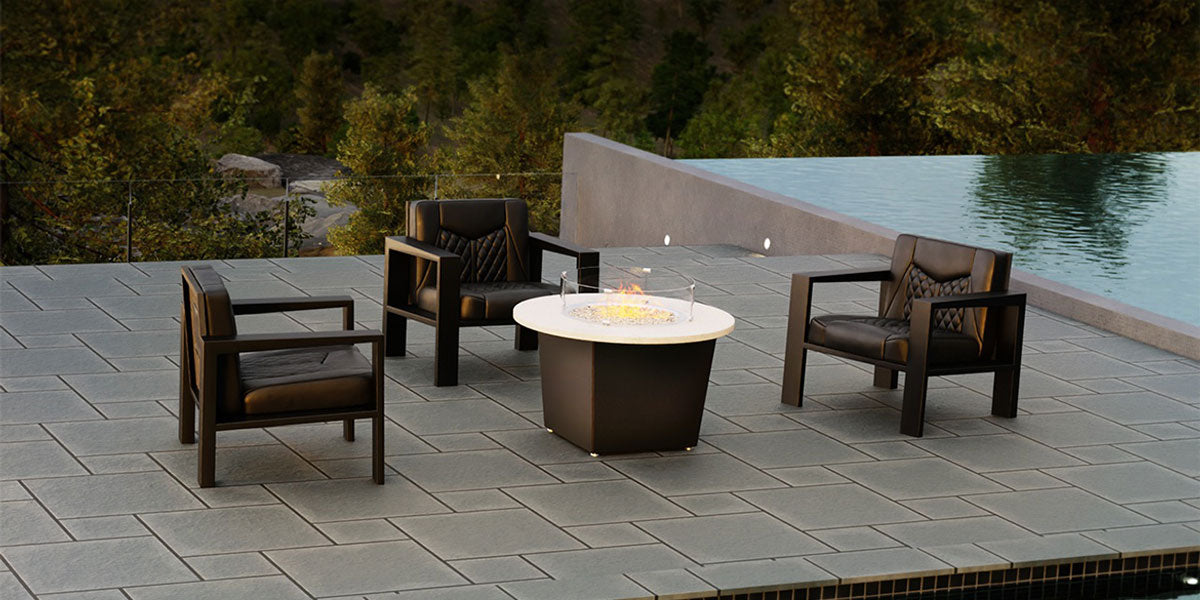
Key Takeaways:
- Guest capacity drives BTU requirements. Allocate 10,000-15,000 BTUs per guest with corresponding diameter increases: 24"-30" pits serve 2-4 people at 40-70K BTUs, while 48"+ installations accommodate 6-10+ guests at 150-250K+ BTUs.
- Fuel type determines operating economics. Natural gas costs approximately $0.12 per 1,000 BTU versus propane at $0.65 per 1,000 BTU—a 65K BTU unit runs $80/year on gas versus $423/year on propane at 100 hours of use.
- Poolside installations require 50% greater setbacks. A 36" fire pit needs 20 feet clearance poolside versus 15 feet for standard patio placement. Coastal locations within 5 miles of the ocean demand 316 stainless steel components.
- Setback requirements often constrain maximum size. Maintain 10-25 feet clearance from structures, depending on fire pit diameter, with 15 feet minimum overhead clearance. Verify available yard depth before finalizing dimensions.
- Total installation costs range from $3,250-$16,500+. Budget includes fire pit unit ($500-$5,000+), gas line installation ($1,000-$4,000), labor ($1,500-$6,000+), and permits ($250-$1,500). Commercial installations start at $15,000.
Selecting the correct fire pit size determines project success—from code compliance and guest comfort to long-term operating costs. This comprehensive fire pit size guide provides pool and landscape contractors with the technical specifications needed to spec residential, poolside, and commercial installations confidently.
Whether you're sizing traditional fire pits or modern fire pit tables, understanding the relationship between diameter, BTU output, seating capacity, and setback requirements is essential.
This guide delivers the data-driven insights California contractors need to match fire features to site conditions, fuel infrastructure, and client entertainment patterns while ensuring safety compliance and optimal performance.
What Are the Key Factors to Consider When Sizing a Fire Pit for Outdoor Entertainment?
Fire pit sizing isn't arbitrary—it's a calculated decision based on guest capacity, fuel infrastructure, and location requirements. Get these factors right upfront to avoid costly redesigns and ensure code compliance.
How Does Guest Capacity and Fire Pit Size Correlate for Entertainment Spaces?
Guest count directly determines fire pit diameter and BTU requirements. Small fire pits (24"-30" diameter) serve 2-4 people with 40,000-70,000 BTUs and a 3-5 foot heat radius. Medium units (36"-42") accommodate 4-6 guests at 90,000-125,000 BTUs with 5-8 feet of warmth. Large installations (48"+) handle 6-10+ people, delivering 150,000-250,000+ BTUs across an 8-12+ foot radius. Match the BTU output to seating distance—undersize the unit and guests sit too close or stay cold.
Why Is It Important to Account for Fuel Type When Choosing Fire Pit Size?
Fuel type dictates both infrastructure requirements and long-term operating costs. Natural gas operates at 7-10" water column pressure while propane requires 11-13" water column. A standard 3/4" flex line handles up to 255,000 BTUs; exceed that and you need a dual flex line kit. Operating costs tell the real story: a 65K BTU unit costs $0.80/hour on natural gas versus $4.23/hour on propane—that's $80 versus $423 annually at 100 hours of use. Scale up to 125K BTUs and you're looking at $153/year (gas) versus $814/year (propane). Choose natural gas for permanent installations; reserve propane for remote locations without gas access.
How Does Fire Pit Location (Backyard, Poolside, Commercial) Influence Sizing?
Location determines setback requirements and material specifications. Poolside installations demand increased clearances: 15-30 feet versus standard 10-25 feet, depending on fire pit size. Coastal projects within 5 miles of the ocean require 316 stainless steel for all metallic components to resist salt air corrosion. Wildland-Urban Interface (WUI) zones impose enhanced restrictions beyond California Fire Code minimums. Survey site conditions and local jurisdiction requirements before finalizing dimensions—setbacks often force downsizing or relocation.
How Do Fire Pit Shapes Affect the Ideal Size for Different Outdoor Spaces?
Shape determines seating flow and space efficiency. Round designs foster conversation, square units support formal arrangements, and linear tables maximize seating for larger groups.
What Seating Arrangements Work Best With Circular and Round Fire Pits?
Circular fire pits create a natural focal point that draws guests into intimate conversation. Curved or circular seating arcs optimize sightlines across the fire feature—everyone sees everyone. This shape works best for casual gatherings where social interaction takes priority over structured seating plans.
How Do Square Fire Pits Support More Structured Seating for Formal Gatherings?
Square fire pits align with architectural grid patterns and support symmetrical seating arrangements. The straight edges accommodate built-in benches and formal furniture layouts common in commercial and high-end residential projects. Use square designs when the overall landscape follows geometric principles or requires defined seating zones.
Why Are Rectangular or Linear Fire Tables Better for Larger Group Settings?
Rectangular fire pit tables create a natural focal point for group gatherings, offering extended seating along both sides for easy conversation and balanced warmth. Their elongated design provides efficient use of space—perfect for 8 or more guests in social or dining layouts.
These linear forms pair effortlessly with modern outdoor furniture, making them a favorite in hospitality settings such as hotel patios, resort lounges, and poolside areas. The streamlined shape complements contemporary architecture while ensuring consistent heat distribution across the entire table length, keeping every seat comfortable.
When designing for spacious patios or commercial environments, rectangular fire pit tables deliver the perfect combination of function, style, and scalability for larger groups.
How Does Fire Pit Size Impact Comfort and Safety in Outdoor Entertainment Areas?
Proper clearances prevent accidents and ensure comfortable circulation. Size affects flame height, heat distribution, and required safety zones around the fire feature.
What Clearance Is Required Between Seating and Fire Pit for Safety?
Maintain minimum 36 inches of clear space around the entire fire pit perimeter for comfortable passage. Egress paths require at least 36 inches width, free of obstructions. Orange County code mandates minimum 2" clear space between fireplaces and combustible construction. These aren't suggestions—they're code minimums that inspectors verify.
How Does Flame Height and Seating Proximity Affect the Entertainment Experience?
Flame height scales with fire pit diameter: 24" pits produce 8-12" flames, 36" units generate 12-18", 48" models create 18-24", and 60" installations reach 24-36". Taller flames push heat further but reduce intimacy. Position seating based on BTU output and heat radius—too close creates discomfort, too far leaves guests cold. Balance warmth with conversation distance.
How Can Wind Guards Enhance Safety and Comfort When Using Larger Fire Pits?
Tempered glass wind guards protect flames from coastal winds while maintaining visibility. They create an additional safety barrier between the flame and surrounding area, preventing accidental contact. Wind guards reduce heat loss in windy conditions, improving fuel efficiency. Essential for poolside and elevated installations where wind exposure compromises flame stability.
What Size Fire Pit Is Ideal for Different Outdoor Spaces (Residential, Poolside, and Commercial)?
Application determines size requirements. Residential backyards need intimate scales, poolside installations require expanded setbacks, and commercial spaces demand larger capacities with higher BTU outputs.
What Size Fire Pit Works Best for Residential Backyards?
Small patios (~150 sq ft) require minimum 10,000 BTUs for adequate warmth. A 24" diameter pit seats 2-4 people with a 12" burner ring delivering 40-70K BTUs at a 10-foot setback. Scale up to 30" for 3-5 guests using an 18" burner ring at 60-90K BTUs with the same 10-foot clearance. The 36" diameter accommodates 4-6 people via a 24" burner ring producing 90-125K BTUs, but requires a 15-foot setback. Choose based on typical guest count and available yard depth—setback requirements often dictate maximum size.
How Does Fire Pit Size Vary for Poolside vs. Patio Installations?
Poolside installations require 50% greater setbacks than standard patio placement. A 24" pit needs 15 feet versus 10 feet standard. The 36" unit jumps to 20 feet from 15 feet. A 48" installation demands 25 feet versus 20 feet, and a 60" pit requires 30 feet versus 25 feet. The increased clearances account for pool decking, traffic flow, and water proximity. Verify local amendments—some jurisdictions impose even stricter poolside requirements.
What Fire Pit Sizes Are Required for Commercial Spaces Like Restaurants and Resorts?
Commercial applications start at 42" diameter, seating 5-7 people with a 30" burner delivering 120-150K BTUs. Extra-large 54" units accommodate 7-9 guests via 42" burners producing 180-250K BTUs. The largest commercial installations—60" diameter with 48" burners—serve 8-10 people at 200-300K BTUs. Commercial spaces prioritize capacity and visual impact over intimate scale. Factor in higher insurance requirements and mandatory Fire Authority approval before permit issuance.
How Does Fire Pit Size Relate to the Fuel Source (Propane vs. Natural Gas)?
Fuel type constrains size options and determines operating economics. Natural gas suits permanent installations with higher BTU capacities, while propane offers portability at premium cost.
How Does Fuel Type Influence the Maximum and Minimum Size of a Fire Pit?
Natural gas works best for permanent installations with direct access to the home's gas supply—no practical size limit with proper line sizing. Propane requires higher pressure and specific regulators, limiting practical applications. A standard 20-lb propane tank (15 lbs actual fill) contains 320,600 BTU total—just 4.9 hours runtime for a 65K BTU pit or 2.6 hours for a 125K BTU unit. Larger propane installations need bulk tanks or frequent refills, adding logistical complexity.
What Are the Operational Differences in Sizing for Propane vs. Gas Fire Pits?
Operating costs diverge dramatically by fuel type. Natural gas runs approximately $0.12 per 1,000 BTU versus propane at $0.65 per 1,000 BTU. A 90K BTU unit costs $1.10/hour on gas versus $5.86/hour on propane. Scale to 125K BTUs: $1.53/hour (gas) versus $8.14/hour (propane). At 165K BTUs, expect $2.02/hour (gas) versus $10.74/hour (propane). Over a season, propane costs 5x more than natural gas for identical heat output.
How Does a Fire Pit's Fuel Source Affect Its Maintenance and Service Requirements?
Natural gas provides consistent supply with zero refill logistics—just turn the valve. Propane demands tank monitoring and refills at $15-25 per 20-lb tank, with larger units requiring scheduled bulk deliveries. Natural gas installations require plumbing permits ($150-400) and inspection fees ($100-200 per inspection), but these are one-time costs. Factor permit expenses into project budgets—they're mandatory, not optional.
How Does Fire Pit Size Influence Seating Arrangements and Social Flow?
Fire pit diameter dictates seating capacity and interaction patterns. Smaller units foster intimacy, larger installations accommodate crowds, and proper integration with furniture maximizes social engagement.
What Size Fire Pit Is Ideal for Intimate Gatherings (4–6 People)?
A 30" diameter pit seats 3-5 people comfortably at 60-90K BTUs. The 36" diameter accommodates 4-6 guests with 90-125K BTUs. Both sizes heat medium areas up to 150 square feet effectively. These scales promote conversation without shouting across excessive distance—ideal for family gatherings and small dinner parties.
How Do Larger Fire Pits Support Seating for Groups of 10 or More?
A 54" diameter unit seats 7-9 people with 180-250K BTUs and requires a 20-foot setback. The 60" diameter handles 8-10 guests at 200-300K BTUs with a 25-foot clearance. Large areas need 50,000-150,000 BTUs minimum for adequate heating across expanded seating zones. Plan for proportionally larger footprints—setback requirements consume significant yard depth.
How Do Fire Pits Integrate With Sectional Seating for Better Social Interaction?
Curved seating arcs follow the fire pit's perimeter, facilitating conversation and creating natural focal points. For fire tables, provide ADA-compliant knee and toe clearance: 27 inches high, 30 inches wide, 19 inches deep. This ensures wheelchair access and universal usability. Position sectionals within the heat radius but outside the minimum 36-inch clearance zone for optimal comfort and code compliance.
What Size Fire Pit Is Best for Commercial and Hospitality Spaces?
Commercial applications demand larger scales, higher budgets, and stricter safety compliance. Installations range from $15,000 to $50,000+ with enhanced clearances and mandatory Fire Authority approval.
How Do Fire Pit Sizes Scale for Outdoor Lounge Areas in Resorts and Hotels?
Commercial installations start at 48" diameter, seating 6-8 people with 150-200K BTUs. Budget $15,000-$50,000+ depending on scope—luxury installations include custom stone work and integrated seating that elevate the feature beyond basic function. Commercial-grade units require robust construction to withstand constant use and weather exposure. Specify 316 stainless steel components and commercial warranties to protect the investment.
What Are the Safety, Heating, and Aesthetic Considerations for Large Fire Pits in Commercial Spaces?
Commercial setbacks require 20-25 feet minimum from structures for larger units—more restrictive than residential codes. Maintain minimum 15 feet overhead clearance to any combustible structure like pergolas or shade sails. Fire Authority approval is mandatory before permit issuance—submit plans early to avoid construction delays. Commercial spaces face enhanced liability; non-compliance risks operating permits and insurance coverage.
How Do Fire Pit Sizes Complement Different Seating Styles in Event Venues?
Linear fire table designs accommodate modular furniture arrangements common in event venues—guests reconfigure seating for different group sizes. Maintain minimum 36-inch clear pathways for accessibility and emergency egress. Accessible routes require firm, stable, slip-resistant surfaces per ADA standards—critical for commercial occupancy permits. Design circulation first, then position fire features within the remaining footprint to ensure code compliance.
How Can Fire Pit Size Impact Fuel Efficiency and Operational Costs?
Size affects both fuel consumption and total project costs. Efficient burner design matters more than raw BTU ratings, and installation expenses scale with complexity.
What Size Fire Pit Optimizes Fuel Consumption for Both Residential and Commercial Settings?
Crossfire burners deliver extreme efficiency regardless of size—they operate effectively even at 70% of rated fuel capacity. A gas line supplying 150K BTUs can successfully run a 180K BTU burner without performance loss. This overcomes undersized gas line issues common in retrofit projects. Prioritize burner efficiency over maximum BTU ratings to reduce operating costs without sacrificing heat output.
How Does Fire Pit Size Affect the Frequency of Maintenance and Operational Costs?
Total installation costs range $3,250-$16,500+ excluding site work and seating. Fire pit units run $500-$5,000+, gas line installation adds $1,000-$4,000, and labor costs $1,500-$6,000+ for 2-4 days with 2-3 installers. Permits consume $250-$1,500 depending on jurisdiction. Larger units require proportionally higher investment but don't necessarily increase maintenance frequency—component quality matters more than size. Budget 15-20% contingency for unexpected site conditions.
What Are the Advantages and Disadvantages of Different Fire Pit Sizes for Entertaining?
Size determines guest capacity, heat distribution, and installation constraints. Larger units serve crowds but demand space and budget; smaller installations foster intimacy at lower cost.
What Are the Benefits of Larger Fire Pits for Hosting Larger Groups?
Fire pits 48"+ serve 6-10+ people effectively with room for comfortable seating spacing. Higher BTU output (150-250K+) projects heat across an 8-12+ foot radius, warming larger gathering areas. These scales suit commercial and hospitality applications where guest capacity and visual impact justify the investment. Larger installations create destination features that anchor outdoor entertainment zones.
How Can Smaller Fire Pits Contribute to a More Intimate Outdoor Atmosphere?
Fire pits 24"-30" create a 3-5 foot heat radius ideal for 2-4 people in close conversation. Lower operating costs make 40-70K BTU units the most economical choice for residential use. The minimum 10-foot setback allows closer integration with outdoor living spaces, maximizing usable yard area. Smaller scales feel appropriate for typical family gatherings without overwhelming compact patios.
What Are the Trade-Offs Between Size, Portability, and Permanence in Outdoor Fire Pits?
Portable outdoor fireplaces require 15 feet from structures per California Fire Code Section 307.4.3. Recreational fires demand 25 feet (Section 307.4.2). Permanent natural gas installations offer lower lifetime operating costs but require higher upfront investment and lose relocation flexibility. Portable units accommodate renters and seasonal use; permanent installations suit established properties with dedicated outdoor rooms. Choose based on tenure, budget, and usage patterns—don't install permanent infrastructure for short-term residency.
How Do You Choose the Right Fire Pit Size for Your Project (Based on Space and Audience)?
Selection requires balancing guest capacity, available space, and budget constraints. Use sizing charts as baseline references, then adjust for site-specific conditions and client entertainment patterns.
How Can Contractors Use Sizing Charts to Select Fire Pit Dimensions?
Complete sizing tables provide diameter (24"-60"), seats served, burner ring size, BTU range, flame height, and setback requirements in one reference. Follow the BTU-to-seating correlation: every 2-3 additional guests requires approximately 30-40K BTU increase. Start with typical guest count, match to corresponding diameter and BTU output, then verify setback compliance with available yard depth. Sizing charts eliminate guesswork and prevent undersized installations that disappoint clients.
What Are the Best Fire Pit Sizes Based on Your Space's Overall Design and Client Preferences?
Small patios (~150 sq ft) perform best with 40,000-60,000 BTUs—adequate warmth without overwhelming the space. Medium areas suit 90,000-125,000 BTUs for 4-6 people with balanced proportions. Large areas demand 150,000-250,000+ BTUs to serve 6-10+ guests across expanded seating zones. Scale the fire pit to the room's visual weight—undersized units disappear in large spaces, oversized installations dominate small patios. Match client entertainment frequency to investment level.
How Can You Calculate the Best Fire Pit Size for Entertaining Groups of Various Sizes?
Allocate approximately 10,000-15,000 BTUs per guest for adequate warmth. Add 36" minimum clearance around the entire fire pit perimeter for circulation and safety compliance. Position seating within the effective heat radius: 3-5 feet for 40-70K BTUs, 5-8 feet for 90-125K BTUs, 8-12+ feet for 150-250K+ BTUs. Work backwards from available space—measure yard depth, subtract setback requirements, then calculate maximum fire pit diameter and corresponding guest capacity. Verify the result matches client expectations before finalizing specifications.
Get Expert Help on Fire Pit Sizing from So-Cal Fire Pits
Choosing the right fire pit size for your patio requires balancing code compliance, guest capacity, and fuel infrastructure—all while meeting client expectations. So-Cal Fire Pits specializes in helping pool and landscape contractors navigate these complexities with precision.
Our comprehensive fire pit size guide eliminates guesswork with detailed specifications for residential, poolside, and commercial installations across Southern California. Whether you're designing an intimate backyard gathering space, selecting fire bowls for pools in luxury resort settings, or planning commercial-scale fire features, our team delivers the technical expertise and product knowledge you need to spec correctly the first time.
Contact So-Cal Fire Pits today to discuss your next project and ensure code compliance with client satisfaction guaranteed.
You may also like
View all

