
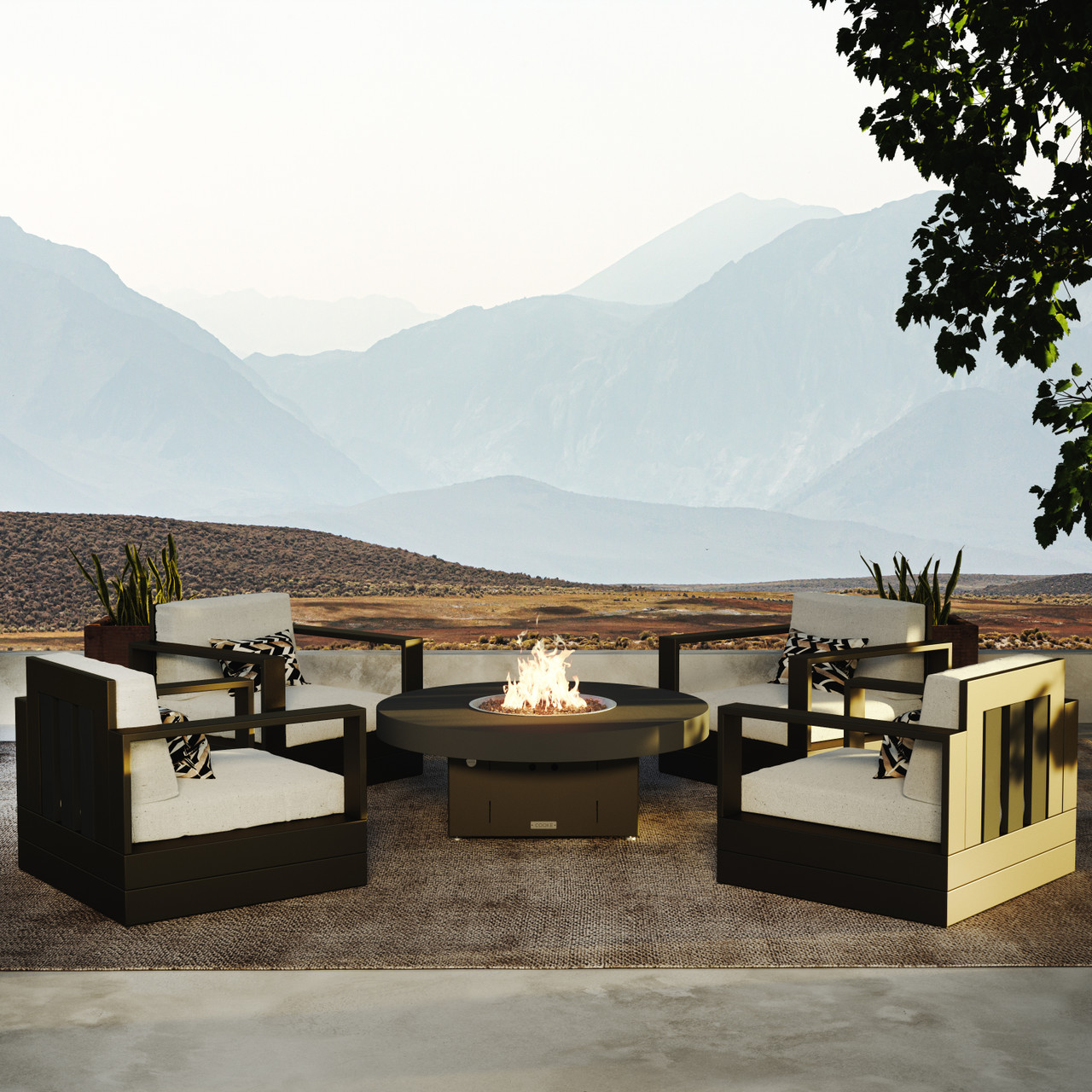
Key Takeaways
- Mid-Tier Installations Offer Optimal ROI Fire pit investments ranging from $2,240-$6,550 deliver the best balance with 135-191% property value ROI and payback periods of 0.30-0.52 years, making them ideal for most luxury residential projects.
- Natural Gas Provides Long-Term Cost Efficiency Natural gas fire pits operate at $0.44-$1.31 per hour—significantly lower than propane's $0.83-$2.48 range—while delivering superior BTU output (30,000-180,000) and heat coverage (4-7 feet) for permanent installations.
- Premium Materials Justify Higher Upfront Investment Stainless steel (15-20 years), natural stone (25-40 years), and Corten steel (30+ years) eliminate replacement cycles that plague painted steel (3-5 years), reducing total ownership costs despite higher initial prices.
- Strategic Enhancements Dramatically Increase Usage Wind guards, supplemental heating, and overhead structures can boost annual usage from 180 baseline hours to 405+ hours in mild climates—a 125% increase that maximizes investment value and creates year-round outdoor living spaces.
- Property Value Increases Scale with Investment Tier Fire pits add 0.5-6.0% to luxury home values ($2,500-$30,000), with budget installations gaining 0.5-1.0%, mid-tier adding 1.5-2.5%, premium contributing 3.0-4.0%, and luxury features commanding 4.5-6.0% increases.
Fire pits have evolved from basic backyard features into strategic investments that enhance luxury property values and extend outdoor living seasons. For homeowners and contractors planning high-end residential projects, understanding the financial implications of fire pit installations is essential for maximizing return on investment.
This guide examines the complete cost spectrum—from budget-friendly fire pit options starting at $690 to luxury architectural features exceeding $31,000. We’ll explore how material selection, fuel type, and strategic enhancements impact both property values and usage patterns, including the added value of luxury fire pit tables.
This data-driven analysis will help you determine the optimal investment level for your luxury home project, balancing fire pit budget considerations with long-term value.
Why Are Fire Pits Essential for Luxury Outdoor Living Spaces?
Fire pits transform outdoor areas into year-round gathering spaces that directly impact property value and homeowner lifestyle. They serve as functional heating sources and architectural focal points that define premium outdoor living environments.
How Fire Pits Enhance Property Value in Luxury Homes
Fire pits deliver measurable returns on investment through property value appreciation. Installations increase home values by 0.5% to 6.0%, generating $2,500 to $30,000 in added equity for luxury properties. Budget installations ($690-$2,250) add 0.5-1.0% in value, while mid-tier systems ($2,240-$6,550) contribute 1.5-2.5%. Premium installations ($5,440-$13,700) boost values by 3.0-4.0%, and luxury features ($11,990-$31,000+) command 4.5-6.0% increases.
The investment tier determines both immediate appraisal impact and long-term market appeal. Higher-tier installations position properties as turnkey luxury homes with established outdoor living infrastructure.
The Role of Fire Pits in Creating Memorable Outdoor Experiences
Fire pits extend outdoor living seasons and increase property engagement time. Budget systems generate 180-220 annual usage hours, while mid-tier installations reach 280-320 hours. Premium features deliver 350-400 hours, and luxury setups achieve 420-480 hours per year. This translates to lifestyle value ranging from $900 to $2,400 annually depending on tier.
Strategic enhancements amplify usage dramatically. Wind guards, patio heaters, and overhead structures can boost annual hours by 125% in mild climates—expanding baseline usage from 180 to 405 hours. This extended engagement creates consistent outdoor living patterns that justify premium home pricing.
How Should Homeowners and Contractors Budget for a High-End Fire Pit?
Budgeting for fire pit installations requires analyzing upfront costs, operational expenses, and return timelines. Investment tiers range from $690 to $31,000+, with mid-range options typically delivering the strongest financial performance for luxury residential projects.
Estimating Initial Investment Costs for Premium Fire Features
Fire pit investments break into four distinct tiers based on materials, features, and installation complexity. Budget systems cost $690-$2,250 and provide entry-level functionality. Mid-tier installations range from $2,240-$6,550 and include professional-grade materials with enhanced features. Premium systems ($5,440-$13,700) incorporate designer materials and integrated controls. Luxury installations ($11,990-$31,000) represent custom architectural features with comprehensive automation.
Mid-tier systems deliver optimal financial balance with 135-191% property value ROI. This tier offers professional materials and features without the diminishing returns seen in luxury installations.
The Impact of Customization on Pricing and ROI
Customization level directly affects both investment recovery time and total return percentage. Budget installations recover costs in 0.28-0.45 years with 100-222% ROI—the highest percentage returns. Mid-tier systems payback in 0.30-0.52 years with 135-191% ROI. Premium features require 0.36-0.69 years with 110-146% returns, while luxury installations need 0.53-1.03 years and generate 81-97% ROI.
Budget tiers maximize ROI percentages but mid-tier installations balance financial return with material quality and longevity. Luxury tiers prioritize statement features over pure financial metrics.
Fuel Type and Maintenance Considerations in Budgeting
Ongoing operational costs vary significantly by fuel type. Natural gas offers the most economical operation at $0.44-$1.31 per hour, totaling $88-$262 annually for 200 hours of use. Propane costs $0.83-$2.48 hourly ($166-$496 annually), while wood ranges from $0.35-$1.15 per hour ($70-$230 annually) with variable pricing.
Annual maintenance adds $75-$200 for gas and propane systems requiring bi-annual professional service. Wood-burning units cost $50-$150 annually but demand monthly cleaning during active use. Natural gas provides the lowest total cost of ownership for permanent installations when combining fuel efficiency with maintenance requirements.
What Are the Key Considerations When Choosing a High-End Fire Pit?
Material selection, fuel type, and design features determine fire pit performance and longevity. These decisions impact installation costs, maintenance requirements, and total ownership value over the system's lifespan.
Material Quality and Durability: Why Premium Materials Matter
Material choice directly correlates with replacement frequency and long-term costs. Painted steel lasts 3-5 years, while powder-coated steel extends to 5-8 years. Cast iron provides 10-15 years of service. Stainless steel delivers 15-20 years, copper and concrete offer 20-30 years, and natural stone reaches 25-40 years. Corten steel exceeds 30 years with minimal maintenance.
Premium materials justify higher upfront investment through extended lifespan and reduced replacement cycles. A $4,000 natural stone installation lasting 30 years costs less annually than a $800 painted steel unit requiring replacement every 4 years.
Choosing Between Propane and Gas: What to Factor in for Budget
Natural gas requires permanent infrastructure with $800-$8,000 installation costs but delivers 30,000-180,000 BTU output and 4-7 foot heat coverage. Propane offers portable flexibility with $200-$3,000 installation costs, generating 30,000-100,000 BTU and 3-6 foot coverage.
Natural gas suits permanent luxury installations requiring high heat output and extended range. Propane works for flexible layouts or properties without gas line access. Installation complexity favors propane for retrofit projects and natural gas for new construction integration.
The Aesthetic and Functional Aspects of Fire Pit Design
Design sophistication scales with investment tier and BTU capacity. Budget systems ($690-$2,250) provide basic fire bowls with 30,000-60,000 BTU output. Mid-tier installations ($2,240-$6,550) include wind guards, covers, and basic controls with 50,000-75,000 BTU. Premium features ($5,440-$13,700) add remote ignition, LED lighting, and premium seating at 70,000-100,000 BTU.
Luxury systems ($11,990-$31,000) integrate smart controls, audio systems, and custom architectural design with 90,000-150,000+ BTU output. Higher BTU ratings extend effective heating radius and support larger gathering spaces in luxury outdoor environments.
The Cost Breakdown of Premium Fire Pits: What Are You Paying For?
Fire pit costs extend beyond the base unit to include materials, professional installation, permits, and enhancement accessories. Understanding these components helps contractors and homeowners allocate budgets effectively across all project elements.
The Cost of Materials: Stone, Concrete, and Other Luxury Options
Material costs span a wide range based on durability and aesthetic value. Painted steel starts at $300-$800, while powder-coated steel runs $500-$1,500. Cast iron ranges from $800-$2,500. Stainless steel costs $2,000-$8,000, copper reaches $3,000-$10,000, and Corten steel spans $3,000-$15,000. Concrete installations run $2,500-$12,000, while natural stone commands $4,000-$20,000.
Annual maintenance costs reflect material characteristics. Painted steel requires $100 annually, stainless steel needs $150, concrete and stone demand $150-$200, and Corten steel requires minimal $50 upkeep. Long-term ownership costs favor premium materials despite higher initial investment.
Installation Costs: What Contractors and Homeowners Need to Know
Installation complexity increases with system sophistication. Budget tiers allow DIY or basic installation. Mid-tier systems require professional installation for optimal performance. Premium installations mandate professional service, while luxury projects involve architects or designers for integrated outdoor living design.
Permit and compliance costs vary by fuel type and local requirements. Gas fire pits total $1,000-$4,450 including permits, professional installation, and safety equipment. Propane systems range from $200-$1,350. Wood-burning installations cost $150-$1,750. These expenses ensure code compliance and long-term safety.
Additional Customization Costs: Size, Shape, and Special Features
Enhancement accessories significantly impact functionality and usage rates. Fire pit covers cost $50-$400 for weather protection. Glass wind guards ($100-$1,000) provide the highest accessory ROI with 15% usage increases. Seating for four ranges from $400-$8,000 and boosts usage 20%. Ambient lighting ($100-$2,000) adds 15% more hours, while supplemental patio heaters ($150-$2,500) increase usage 25%. Pergolas or overhead structures ($1,000-$20,000) deliver 40% usage gains.
Strategic enhancement packages optimize investment. The Essential Trio (wind guard, seating, cover) costs $550-$9,400. Year-Round Packages run $900-$14,900. Ultimate Setups with full amenities reach $2,100-$38,900. These packages transform seasonal features into year-round outdoor living centers.
How Do Fuel Types Affect the Overall Cost of a Luxury Fire Pit?
Fuel selection impacts installation costs, operational expenses, and design flexibility. Natural gas and propane offer distinct advantages based on property infrastructure, usage patterns, and long-term ownership goals.
Propane Fire Pits: Flexibility vs. Cost
Propane systems prioritize portability and installation simplicity. Tanks enable relocation without infrastructure modifications, making propane ideal for evolving outdoor layouts. Push-button or manual ignition provides instant heat with no warm-up period. Permit requirements vary by jurisdiction but are less stringent than natural gas installations.
Propane generates 4.46-13.37 lbs of CO2 per hour depending on BTU output. Year-round reliability remains excellent with proper tank storage in temperature-controlled areas. Higher per-hour operating costs ($0.83-$2.48) offset lower installation expenses, making propane suitable for moderate-use scenarios or temporary installations.
Gas Fire Pits: Long-Term Savings and Efficiency
Natural gas installations require permanent infrastructure but deliver superior long-term economics. Fixed positioning integrates fire pits into comprehensive outdoor designs. Push-button and remote ignition systems offer convenience with smart home compatibility. Permits are typically required due to gas line installation complexity.
Natural gas produces 3.54-10.62 lbs of CO2 per hour—lower emissions than propane at comparable BTU levels. Year-round reliability is excellent with no fuel storage concerns. Operating costs of $0.44-$1.31 per hour make natural gas the most economical choice for high-use installations, from backyard fire pits to a high end fire bowl for pools where extended evening use is common. The 30,000-180,000 BTU output range supports both intimate settings and large gathering spaces, justifying higher upfront investment through operational savings.
What Are the Maintenance and Longevity Factors to Consider?
Maintenance requirements and lifespan projections directly affect the total cost of ownership. Service frequency, warranty coverage, and weather resistance determine long-term value beyond initial purchase price.
Maintenance Costs for Different Fire Pit Types
Gas and propane systems require bi-annual professional service for burner inspection, gas line checks, and ignition system testing. Wood-burning units demand monthly cleaning during active seasons including ash removal, grate maintenance, and structural inspection. This frequency difference significantly impacts labor costs and owner time investment.
Maintenance burden scales with investment tier. Budget installations require high DIY involvement for cost control. Mid-tier systems need occasional professional service supplemented by owner upkeep. Premium installations rely primarily on professional maintenance schedules. Luxury tiers include concierge services with proactive scheduling and comprehensive coverage, minimizing owner responsibility.
How Long Can You Expect Your High-End Fire Pit to Last?
Warranty coverage reflects manufacturer confidence in longevity. Budget systems offer 1-2 year warranties covering basic defects. Mid-tier installations provide 3-5 years of coverage. Premium units include 5-10 year warranties on critical components. Luxury installations feature 10-25 year warranties with some manufacturers offering lifetime coverage on structural elements.
Weather resistance directly correlates with lifespan. Painted steel offers low resistance requiring covered storage or frequent replacement. Powder-coated steel provides medium protection suitable for mild climates. Stainless steel delivers high resistance for most environments. Copper, concrete, and natural stone achieve high to very high ratings for all-weather durability. Corten steel provides very high weather resistance with controlled patina development, making it ideal for exposed luxury installations in harsh climates.
What Are the ROI Expectations for a High-End Fire Pit Installation?
Fire pit ROI encompasses both measurable property value increases and lifestyle value through extended outdoor usage. Investment tier determines financial return profiles and optimal use cases for different property segments.
How Fire Pits Can Increase Property Value in Luxury Projects
Mid-tier installations ($2,240-$6,550) deliver optimal balance for most luxury homes, combining quality materials with strong property value returns. These systems provide professional-grade features without the diminishing returns of ultra-premium installations, making them ideal for properties in the $500,000-$1,500,000 range.
Budget tier installations generate the highest ROI percentages (100-222%), making them effective for testing market appeal before selling or for entry-level luxury properties. Luxury tier systems ($11,990-$31,000) function as signature outdoor features for estate properties exceeding $500,000, where they serve as architectural focal points rather than pure financial investments. Selection should align with overall property positioning and target buyer expectations.
The Potential Return for Homeowners: Value vs. Cost
Usage hours directly correlate with perceived value and justify enhancement investments. Base configurations in mild climates generate 180 annual hours. The Essential Trio (wind guard, seating, cover) increases usage to 252 hours (+40%). Year-Round Packages extend usage to 324 hours (+80%). Ultimate Setups with comprehensive amenities reach 432 hours (+140%), effectively transforming seasonal features into daily-use outdoor rooms.
Cost-effectiveness varies significantly by tier. Budget enhancements ($2,390) add 125 hours annually at $19.12 per additional hour—the most economical option. Mid-tier enhancements ($8,500) gain 180 hours at $47.22 per hour, balancing cost with material quality. Luxury enhancements ($40,700) provide 225 additional hours at $180.89 per hour, prioritizing experience quality over cost efficiency. Homeowners should match enhancement level to property value and intended usage patterns.
Tips for Maximizing Your Investment in a Luxury Fire Pit
Strategic planning optimizes fire pit value through supplier selection, budget allocation, and design customization. Matching investment tier to property type and usage goals ensures maximum return on both financial and lifestyle metrics.
Selecting the Right Supplier for Quality and Service
Supplier selection should align with target buyer profile and property segment. Budget tier suppliers serve first-time homeowners and renters prioritizing affordability. Mid-tier suppliers focus on established homeowners seeking quality-to-cost balance. Premium suppliers cater to luxury homeowners requiring designer materials and professional installation. Luxury tier suppliers specialize in ultra-luxury and estate properties demanding custom architectural integration.
Material selection must account for environmental conditions. Coastal locations require stainless steel or non-ferrous materials (copper, aluminum) to prevent salt corrosion. Stainless steel, copper, and stone provide best longevity across all climates, justifying premium pricing through extended service life and minimal replacement risk.
How to Plan for Long-Term Enjoyment Without Overextending Your Budget
Usage optimization extends value without excessive spending. Base configurations in mild climates (40-60°F) generate 180 annual hours. Strategic enhancements increase usage to 305 hours (+69%), while full optimization reaches 405 hours (+125%). This maximizes per-hour cost efficiency of the initial investment.
Winter usage demonstrates enhancement impact most clearly. Proper additions increase monthly winter hours from 15 to 50—a 233% improvement that transforms fire pits from seasonal accessories into year-round amenities. Homeowners should prioritize enhancements delivering highest usage gains relative to cost, typically wind guards and supplemental heating before pursuing aesthetic upgrades.
Leveraging Customization for Both Aesthetics and Functionality
Customization must satisfy safety requirements before aesthetic preferences. NFPA standards mandate 10-foot clearance from structures and 21-foot overhead clearance. Fire extinguishers ($30-$100) and non-combustible bases ($100-$1,000) are essential safety investments that protect both property and users.
Material selection impacts both appearance and thermal performance. Cast iron and copper provide high heat retention, extending warmth after flame reduction. Concrete and natural stone offer very high heat retention, maintaining ambient temperature hours after use. These materials reduce fuel consumption while improving comfort, delivering functional benefits that justify premium aesthetics in luxury installations.
Is a High-End Fire Pit Worth the Investment for Your Luxury Home Project?
High-end fire pit tables justify their cost through measurable property value gains and extended outdoor living functionality. Data confirms consistent ROI with property value increases of 0.5-6.0% across all investment tiers, translating to $2,500-$30,000 for luxury homes.
Mid-tier installations ($2,240-$6,550) deliver the most balanced returns at 135-191% ROI, combining professional-grade materials with strong financial performance. Natural gas emerges as the most economical fuel choice for permanent installations, offering $0.44-$1.31 per hour operation versus propane's $0.83-$2.48 range. Premium materials—stainless steel, natural stone, and Corten steel—provide 15-40+ year lifespans that offset higher upfront costs through elimination of replacement cycles.
Strategic enhancements transform seasonal accessories into year-round amenities. Usage can extend from 180 baseline hours to 405+ hours annually in mild climates through wind guards, supplemental heating, and overhead structures. This 125% usage increase maximizes per-hour investment value while creating daily-use outdoor environments that justify premium home pricing.
Professional installation and code compliance protect both safety and long-term value. NFPA clearance requirements, proper gas line installation, and non-combustible bases ensure systems perform reliably for decades. For luxury homeowners and contractors, fire pits represent high-return investments that enhance property appeal, extend living space functionality, and deliver quantifiable financial returns through both immediate appraisal impact and sustained market differentiation.
Ready to Transform Your Outdoor Space with a Premium Fire Pit?
SoCal Fire Pits specializes in custom fire pit design and installation for luxury residential projects throughout Southern California. Our team helps homeowners and contractors select optimal materials, fuel systems, and enhancement packages that maximize property value and year-round usability.
Whether you're planning a mid-tier installation for balanced ROI or a signature luxury feature for an estate property, we provide expert guidance from initial consultation through professional installation and code compliance.
Contact SoCal Fire Pits today for a personalized assessment—whether you're considering designer rectangle fire pit tables for streamlined entertaining or exploring other configurations for your space. Discover how the right fire feature investment can elevate your outdoor living experience while delivering measurable returns.