
Key Takeaways:
- Code compliance isn't negotiable: California Fire Code mandates specific setbacks by fire pit type—15 feet for portable units, 25 feet for recreational fires, 50 feet for open burning. Orange County adds chimney requirements (7' from property lines, 10' from buildings). Constant attendance with 4-A-rated fire extinguishers is mandatory.
- Size determines everything: Match pit diameter to group size and BTU output—24" pits serve 2-4 people with 40-70K BTUs, while 60" units accommodate 8-10 people requiring 200-300K BTUs. Poolside installations demand 5-15 feet of additional setback beyond standard clearances.
- Fuel choice shapes long-term costs: Natural gas operates five times cheaper than propane—a 125K BTU unit costs $153 annually on gas versus $814 on propane (100 hours of use). Gas line sizing is critical: 3/4" flex carries 255K BTUs maximum; undersized lines cause the most common performance failures.
- Coastal installations require marine-grade materials: Specify 316 stainless steel for all projects within 5 miles of the coast. The 2% molybdenum content prevents chloride corrosion that destroys 304 grade. While 316 costs 20-30% more upfront, it delivers superior ROI in salt air environments.
- Budget realistically and plan early: California installations range $3,250-$16,500+ (luxury market $3,500-$30,000+). Total project timelines span 8-20 weeks, including design (4-7 weeks), approvals (6-18 weeks), and construction (4-7 days). Peak season (March-October) adds premium pricing and extends lead times to 12-20 weeks.
Fire pit placement rules determine project feasibility before aesthetics enter the conversation. Whether specifying built-in features or fire pit tables, California's complex code landscape demands precision—setbacks, fuel types, ventilation requirements, and environmental factors constrain every decision.
This guide delivers actionable fire pit location ideas grounded in California Fire Code, NFPA standards, and regional best practices. Landscape architects face mounting pressure to balance client vision with regulatory compliance, coastal corrosion challenges, and WUI restrictions.
Master the technical fundamentals—clearances, BTU calculations, material specifications—then refine placement for social function and visual integration. Successful installations start with informed site analysis, not inspiration boards.
What Are the Core Factors to Consider When Choosing Fire Pit Placement?
Fire pit placement begins with three foundational questions: purpose, safety, and site conditions. Each factor constrains the others—a social fire pit needs different spacing than a heating element, while codes and environmental conditions set hard limits on where features can go. Get these basics right before considering aesthetics or convenience.
How Does the Purpose of the Fire Pit (Social, Heating, Aesthetic) Influence Placement Decisions?
Purpose drives everything. Social fire pits need curved or circular seating arcs that create focal points and enable conversation—position seats to allow easy eye contact across the flame. Heating applications require precise BTU-to-distance calculations: 40-70K BTUs heat 3-5 feet (2-4 people), 90-125K BTUs reach 5-8 feet (4-6 people), and 150-250K+ BTUs extend 8-12+ feet (6-10+ people). Balance warmth with comfort—too close overwhelms, too far wastes heat.
How Do Safety Regulations Such as Clearance From Structures and Combustible Materials Impact Placement?
California Fire Code dictates minimum setbacks by fire pit type. Portable outdoor fireplaces require 15 feet from structures (some jurisdictions allow 3 feet with spark arresters at R-3 occupancies). Recreational fires need 25 feet of clearance, while open burning demands 50 feet (15 feet with approved containers). All installations require 15 feet of overhead clearance and 2 inches from combustible construction. Orange County adds chimney-specific rules: 7 feet from property lines, 10 feet from buildings.
Compliance isn't optional. Constant attendance with a 4-A rated fire extinguisher is mandatory. Follow the manufacturer's instructions exactly. Obtain permits per Section 105.5 and secure Fire Authority approval before breaking ground. Orange County requires this approval before permit issuance.
What Environmental Factors (Wind, Sun, Soil, Topography) Must Be Taken Into Account for Fire Pit Placement?
Coastal California presents unique challenges. Winds disrupt flame patterns, reduce heat output, and create safety hazards. The marine layer compounds problems—moisture and salt accelerate corrosion, especially when morning condensation combines with salt particles. Wind patterns carry salt air miles inland, affecting material selection and maintenance schedules even in "protected" locations.
How Does Fire Pit Placement Impact Safety and Compliance?
Safety clearances and code compliance aren't suggestions—they're legal requirements that protect property and lives. Both natural gas and propane installations follow the same setback rules, but size matters more than fuel type. Proper placement also means planning for emergency access and ventilation from day one.
What Are the Required Clearances From Combustibles (Structures, Trees, Plants) Based on Fuel Type (NG vs. LP)?
Maintain a minimum 10-foot setback from combustible structures regardless of fuel type. Poolside installations demand greater distances—15 to 30 feet, depending on pit diameter. Eliminate all conditions that could enable fire spread before ignition.
Size directly determines safe setbacks:
|
Pit Diameter |
Recommended Setback |
Poolside Setback |
|
24" |
10 feet |
15 feet |
|
30" |
10 feet |
15 feet |
|
36" |
15 feet |
20 feet |
|
42" |
15 feet |
20 feet |
|
48" |
20 feet |
25 feet |
|
54" |
20 feet |
25 feet |
|
60" |
25 feet |
30 feet |
How Does the Placement of the Fire Pit Affect Access to Emergency Shut-Off Valves and Gas Meters?
Design for emergency access from the start. Gas lines, regulators, and safety shutoffs need clear, unobstructed paths that don't require excavation or landscape destruction. Balance aesthetics with serviceability—attractive access panels and strategic screening work better than burying everything. Poor access planning creates liability and delays emergency response.
Why Is It Important to Place Fire Pits in Well-Ventilated Areas, and How Does This Impact Installation?
NFPA mandates two vents on opposing sides of every fire pit enclosure, each with 18 square inches minimum free area. These vents prevent dangerous gas accumulation and allow proper air circulation that controls heat buildup. Inadequate ventilation creates explosive conditions and suffocation hazards. Plan vent locations during initial design—retrofitting ventilation into finished enclosures compromises both safety and aesthetics.
How Does Fuel Type Affect Fire Pit Placement and Design?
Fuel choice fundamentally shapes placement strategy, infrastructure requirements, and long-term costs. Natural gas suits permanent installations near existing service lines, while propane offers flexibility for remote locations. Operating costs differ dramatically—natural gas runs five times cheaper than propane for equivalent BTU output.
What Are the Specific Placement Challenges When Using Natural Gas (NG) vs. Propane (LP) for Fire Pits?
Natural gas works best for permanent installations with accessible home supply lines. It operates at 7-10" water column pressure (standard delivery around 7" w.c. or 1/4 PSI) and delivers a consistent supply at lower operating costs. Propane excels in remote or temporary installations but requires 11-13" w.c. pressure, specific regulators, and delivers 2,516 BTU per cubic foot.
Operating cost differences are substantial:
|
BTU Rating |
Natural Gas/Hour |
Propane/Hour |
|
65,000 |
$0.80 |
$4.23 |
|
90,000 |
$1.10 |
$5.86 |
|
125,000 |
$1.53 |
$8.14 |
|
165,000 |
$2.02 |
$10.74 |
Annual costs (100 hours): 65K BTU runs $80 (gas) versus $423 (propane); 125K BTU costs $153 (gas) versus $814 (propane).
How Do You Ensure the Correct Distance Between a Propane Tank and the Fire Pit?
Standard 20-lb tanks (15 lbs actual fill) contain 320,600 BTUs total—enough for 4.9 hours at 65K BTU or 2.6 hours at 125K BTU. Standard grill tanks handle most applications; high-BTU units need larger tanks. Gas line sizing is critical: 3/4" flex line carries up to 255,000 BTUs, dual flex kits handle higher loads, and 1" lines serve extreme applications (440,000 BTU at 20' run). Add approximately 5 feet to pipe length calculations per fitting—90-degree elbows significantly reduce available BTUs.
What Special Considerations Should Be Made for Fire Pits Located Near Water or Outdoor Kitchens?
Specify 316 stainless steel (marine grade) for all installations within 5 miles of the coast. The 2% molybdenum content prevents pitting and crevice corrosion from chlorides that destroy standard 304 stainless steel. While 316 costs 20-30% more upfront, it delivers superior ROI in salt air environments. Inland installations (5+ miles from coast) can use 304 grade. Tempered glass wind guards protect against flames and provide safety barriers in exposed locations.
How Should You Position a Fire Pit in Relation to Seating and Social Flow?
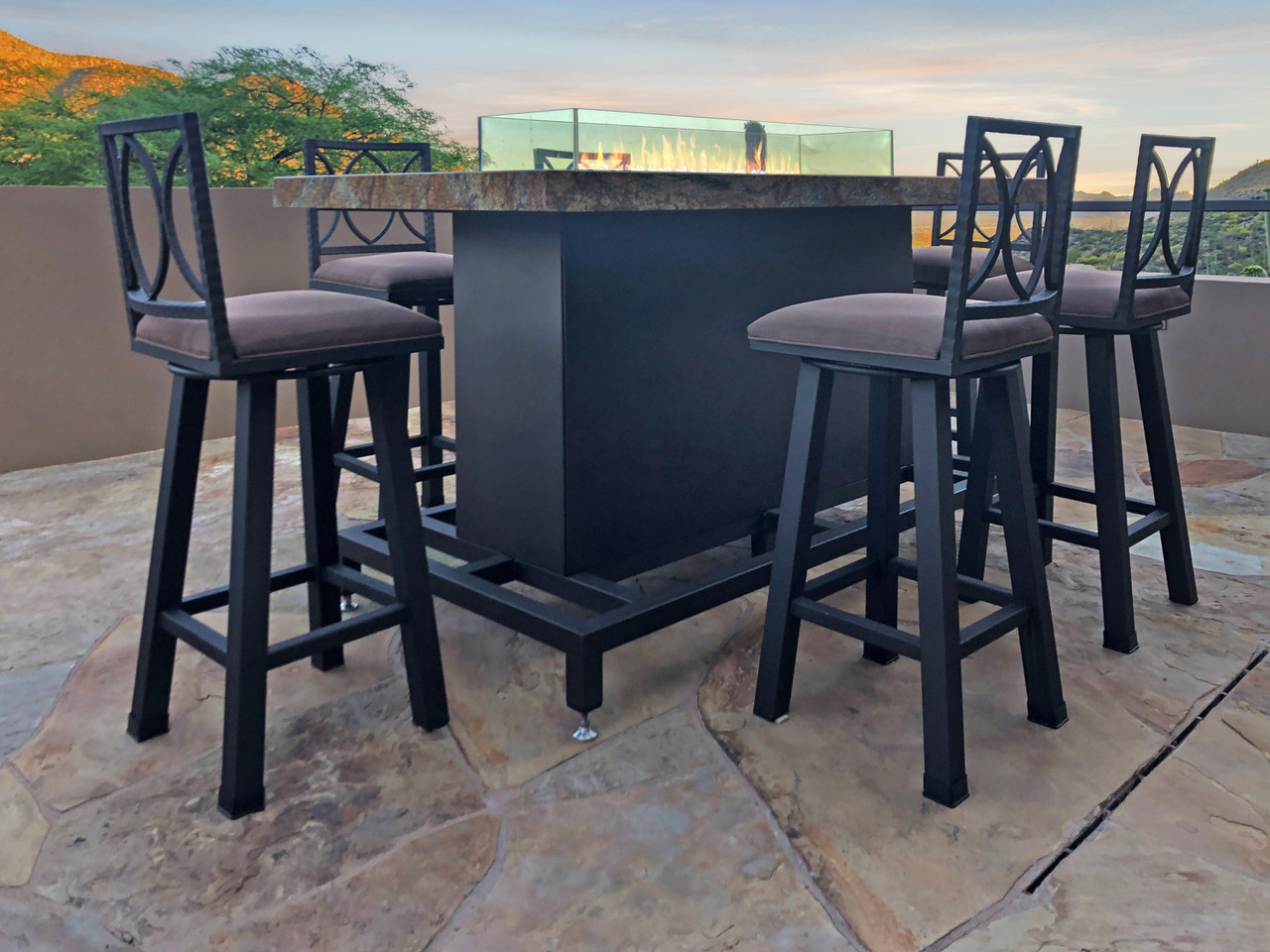
Seating placement transforms a rectangular fire pit table from equipment into an experience. Size determines capacity, BTU output affects comfortable distance, and circulation patterns ensure safety. Balance intimate gathering space with code-compliant egress—trapped guests create liability.
How Do Fire Pit Shape and Size Influence the Ideal Distance for Seating?
Match pit diameter to group size and BTU requirements:
|
Pit Diameter |
Seats Served |
Burner Ring |
BTU Range |
Flame Height |
|
24" |
2-4 |
12" |
40-70K |
8-12" |
|
30" |
3-5 |
18" |
60-90K |
10-15" |
|
36" |
4-6 |
24" |
90-125K |
12-18" |
|
42" |
5-7 |
30" |
120-150K |
15-20" |
|
48" |
6-8 |
36" |
150-200K |
18-24" |
|
54" |
7-9 |
42" |
180-250K |
20-28" |
|
60" |
8-10 |
48" |
200-300K |
24-36" |
Larger pits require proportionally higher BTU output to maintain heat distribution and visual impact across expanded seating arcs.
Why Is It Important to Balance Fire Pit Placement With Other Landscape Features (e.g., Walkways, Patios)?
Maintain 36 inches minimum clear space around the entire fire pit perimeter for comfortable passage. Egress paths must be at least 36 inches wide and completely obstruction-free. Poor circulation creates bottlenecks during evacuation and limits furniture flexibility. Design traffic patterns that separate through-traffic from seating zones.
How Do Different Seating Arrangements (Circle, U-Shape, Linear) Affect the Best Placement of the Fire Pit?
Universal design principles improve usability for all guests. Accessible routes require firm, stable, slip-resistant surfaces leading to and around the fire feature. Fire tables need 27" high, 30" wide, 19" deep minimum knee and toe clearance for wheelchair users. Position controls are within easy reach and ensure one-handed operation. These standards benefit elderly guests and parents with children, even when ADA compliance isn't legally required.
How Does Weather and Environmental Exposure Affect Fire Pit Placement?
California's diverse microclimates demand site-specific strategies. Coastal wind, temperature swings, and seasonal weather patterns affect material selection, anchoring requirements, and project timing. Environmental exposure isn't just about aesthetics—it determines structural integrity and operational reliability.
What Considerations Should Be Made for Fire Pits in Windy Areas, and How Do You Mitigate Flame Disruption?
Wind-resistant burners feature lower profiles, baffled ports, and protective geometries that stabilize flames. Tempered glass wind guards deliver dual benefits—flame protection and safety barriers. Coastal decks and elevated structures require secure anchoring to resist wind loads; specify 316 stainless steel hardware for all coastal installations to prevent anchor point failure from corrosion.
How Do Temperature Extremes (Frost, Heat) Affect Fire Pit Installation and Placement?
Extreme heat affects all stainless grades. Some manufacturers report 316 experiences accelerated oxidation in fire pit applications due to combustion byproducts interacting with molybdenum content at high temperatures. Both 304 and 316 require regular maintenance and proper ventilation to maximize service life. Temperature cycling from frost to fire stresses materials—design drainage to prevent ice formation in burner assemblies.
How Does Seasonal Use Impact Placement Near Structures or Other Landscape Features?
Project timing impacts cost and schedule. Peak season (March-October) brings premium pricing, high demand, and 12-20 week lead times. Off-season (November-February) offers 10-20% discounts and faster 6-12 week timelines, but carries rain delay risk. Schedule permits and approvals during slow months, then execute construction when the weather improves. Year-round placement near structures requires accounting for summer shade patterns and winter wind exposure.
What Are the Aesthetic Considerations for Fire Pit Placement?
Aesthetics drive initial client interest, but functional integration determines long-term satisfaction. Material selection affects placement constraints, lighting design extends usable hours, and media choice reinforces design intent. Visual appeal must coexist with safety clearances and maintenance access.
How Do Materials (Stone, Concrete, Metal) Influence Fire Pit Placement and Integration Into the Landscape?
Material choice shapes both budget and design flexibility:
- Brick ($300-$1,000): High temperature resistance, easy maintenance, traditional aesthetic
- Natural stone ($500-$2,500): Premium durability, rustic character, and weight require a stable substrate
- Concrete ($300-$1,500): Modern appearance, moldable forms, low maintenance
- Metal ($150-$2,000): Portable to custom-built, spans budget ranges, requires corrosion planning
Heavy materials like stone limit relocation options and demand engineered foundations. Lightweight metals offer flexibility but need secure anchoring in wind-exposed sites.
How Does Lighting, Including Fire Pit Illumination and Surrounding Lighting, Affect Placement and Ambiance?
Integrate low-voltage landscape lighting for pathways and seating zones—fire glow alone creates hazardous dark patches. Discreetly placed outdoor speakers enhance ambiance without visual clutter. All electrical components must meet NEC outdoor ratings and local code. Plan conduit routing during hardscape installation; retrofitting electrical after paving completion multiplies costs and compromises aesthetics.
How Do Natural Features Like Trees, Bushes, and Water Bodies Interact With the Fire Pit's Placement?
Media selection reinforces landscape integration and design style:
- Fire glass: Tempered construction, extensive color/size range, modern reflective aesthetic
- Lava rock: Porous and lightweight, rustic appearance, economical for large burner coverage
- Ceramic logs/shapes: Traditional fireplace character, high-temperature rated, realistic flame interaction
Match media to surrounding hardscape and planting palette. Glass complements contemporary water features; lava rock suits naturalistic boulder groupings; ceramic logs bridge traditional architecture.
What Are the Best Practices for Fire Pit Placement in Landscape Architecture?
Successful fire pit placement balances competing demands—safety codes, client budgets, site conditions, and design intent. Master the fundamentals first: clearances, fuel logistics, and environmental factors. Then refine placement for social function and aesthetic integration. Every decision creates cascading consequences for cost, schedule, and long-term performance.
How Can Landscape Architects Prioritize Safety, Aesthetics, and Functionality When Placing Fire Pits?
Budget realism drives project feasibility. California market costs:
|
Item |
Low End |
High End |
|
Fire Pit Unit |
$500 |
$5,000+ |
|
Gas Line Installation |
$1,000 |
$4,000 |
|
Labor |
$1,500 |
$6,000+ |
|
Permits |
$250 |
$1,500 |
|
Total |
$3,250 |
$16,500+ |
San Diego luxury market: gas fire pits run $3,500-$12,000 (includes unit, gas line, media); outdoor fireplaces cost $12,000-$30,000+ (CMU or prefab). Bay Area pricing runs 20-30% higher. California labor rates span $60-$110 per hour. Simple installations take 1-2 days, complex custom projects need 3-7 days, and gas line work adds 1-2 days. Front-load permitting and utility coordination—approval delays kill schedules. Design for maintenance access from day one; inaccessible shutoffs create liability and service nightmares. Specify materials appropriate for microclimate exposure, not aspirational aesthetics. Document code compliance obsessively—inspectors reject assumptions without stamped drawings. Fire pit placement isn't decoration; it's engineered infrastructure that happens to look good.
Get Expert Support from So-Cal Fire Pits for Your Next Project
Navigating fire pit placement rules while delivering stunning fire pit location ideas requires specialized expertise. So-Cal Fire Pits partners with landscape architects and contractors throughout California, providing technical support from initial site assessment through final inspection. We supply custom fire pit features engineered for coastal conditions, WUI compliance, and luxury residential specifications.
Our team understands regional code variations, material performance in California microclimates, and installer workflows that prevent costly delays. Access CAD files, installation guides, and direct consulting for complex projects. Whether you're specifying 316 stainless for marine exposure or optimizing BTU output for poolside installations, we deliver solutions that pass inspection and exceed client expectations.
For expert guidance and custom solutions, contact us today to get started on your next project!